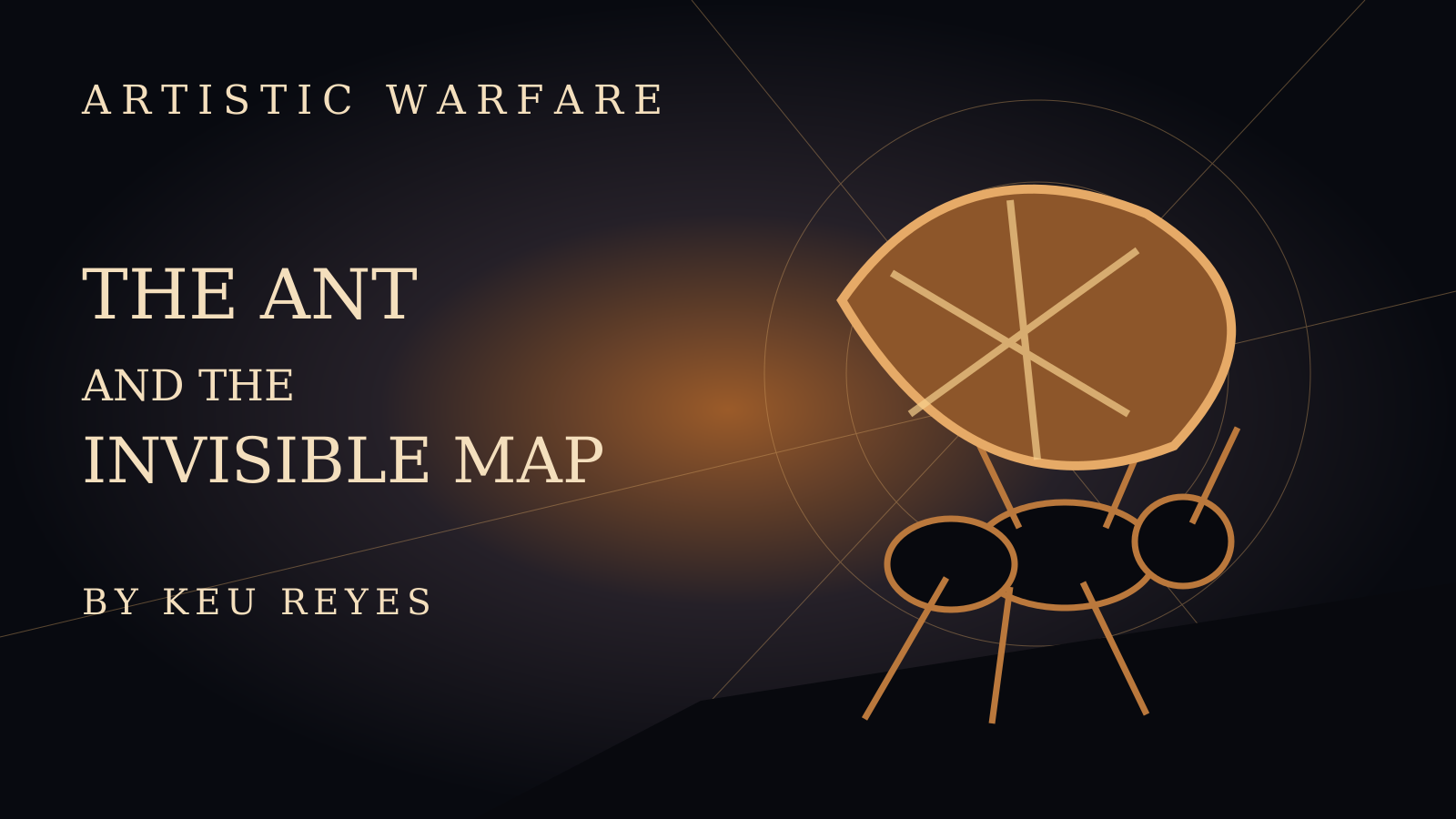
There’s this ant.
A tiny little bastard dragging a piece of bread across a sidewalk on a hot afternoon.
The bread is almost three times his size. One corner keeps scraping against the concrete, catching on every crack. His little legs are moving like crazy, and the sun is cooking everything beneath him.
Still, he keeps going.
He’s got places to be.
Somewhere behind him, hundreds of other ants are marching in a line. They’re carrying crumbs, bits of leaves, pieces of things somebody dropped during lunch.
A whole operation.
No coffee breaks. No complaints about management. No motivational speeches about teamwork.
Just ants doing ant things.
And there’s this one ant, dragging his bread like his entire existence depends on it.
Which, for all I know, it does.
I wonder whether he knows where he’s going.
I mean, really knows.
Does he understand the colony he’s returning to? Does he know how many tunnels exist beneath the ground? How many ants live there? What happens to the food he brings back?
Does he understand the role he plays in keeping that enormous little world alive?
Or is he just following the ant in front of him?
And here’s something even stranger.
Does the ant know that he’s an ant?
Think about that.
He doesn’t know he’s walking across somebody’s driveway.
He doesn’t know there’s a house beside him, a street beyond that house, an entire city surrounding the street.
He doesn’t know about countries, oceans, airplanes, or the ridiculous amount of money people spend trying to leave the planet.
He doesn’t know the Earth is spinning through space.
He’s just trying to get his bread home.
And somehow, I find that admirable.
He’s participating in something much larger than himself without needing to understand the whole thing.
Then something happens.
A gust of wind comes rushing across the driveway.
The bread lifts.
For one glorious second, this little bastard is flying.
Not intentionally, of course.
His transportation arrangements have taken an unexpected turn.
He tumbles across the concrete, lands in a patch of dirt, and loses his bread somewhere beneath a dry leaf.
When he gets up, everything looks different.
The familiar trail is gone.
No ants in front of him.
No ants behind him.
Just dirt, enormous blades of grass, and a world that suddenly seems much bigger than it did a few seconds ago.
If this ant could think like a human, I imagine he’d be having a complete breakdown.
He’d be wondering what he did wrong.
Why this happened to him.
Whether he should have taken another route.
Whether somebody was trying to teach him a lesson.
He might even blame himself for losing the bread.
A perfectly respectable afternoon ruined by one unfortunate gust of wind.
But here’s the interesting part.
A few inches away, hidden beneath a stone, there’s another colony.
One he never knew existed.
Perhaps he’ll find food nearby. Perhaps he’ll encounter danger. Perhaps he’ll discover a way home he would never have found otherwise.
I don’t know.
And neither does he.
But I wonder.
Was losing that bread a disaster, or was it exactly what needed to happen for him to arrive here?
Maybe he was always going to end up beside that stone.
Maybe the bread was never the destination.
Maybe it was simply what got him moving.
And maybe the wind wasn’t an interruption.
Maybe the wind was part of the journey.
Of course, I’m making all kinds of assumptions about this ant.
For all I know, he’s not having an existential crisis. He’s responding to smells, movement, and whatever else nature has given him to navigate his little world.
But I’m the one watching him.
And I can’t help wondering.
Because from where I’m standing, I can see things he cannot.
I can see both colonies.
I can see the driveway, the garden, the street, and the dark clouds beginning to gather above the neighborhood.
I know that if it rains hard enough, parts of his world could disappear beneath a puddle.
I can see a much larger picture.
And then something occurs to me.
What if somebody is looking down at me the same way?
Not necessarily a person.
Not necessarily a god.
Just imagine, for a moment, a perspective so much larger than mine that everything I understand about existence is no more impressive than what that ant understands about the driveway.
What if I’m running around carrying my own ridiculous pieces of bread?
My work.
My relationships.
My house.
My money.
My plans.
All the things I’ve convinced myself are so important.
And what if I’m just as clueless about the larger world I’m participating in?
That’s an uncomfortable thought.
Especially considering how much time I’ve spent believing I know what I’m doing.
I’ve made decisions I was absolutely certain were right.
I’ve made others I thought had ruined my life.
I’ve watched relationships end and convinced myself that something terrible had happened.
I’ve fought to keep things together long after they had stopped making me happy.
I’ve stayed in places because leaving meant giving up an entire world.
The home.
The routines.
The familiar faces.
The family that came with the relationship.
The money.
The furniture.
The strange comfort of knowing exactly what tomorrow would probably look like.
I wasn’t just afraid of losing someone.
I was afraid of losing everything that made my life feel familiar.
And I called that love.
Sometimes it was.
Sometimes, I suspect, it was fear wearing something more respectable.
But how could I know what those endings would eventually mean?
I’ve noticed that we’re remarkably quick to decide whether something is good or bad.
Something terrible happens on Monday, and by Tuesday we’ve declared our lives ruined.
We’re apparently qualified to judge the meaning of our entire existence with forty-eight hours of evidence.
Impressive.
Especially considering most of us can’t even predict what we’re having for dinner next Thursday.
Imagine someone getting into a car accident.
Their car is destroyed.
They’re frightened, angry, overwhelmed.
They call it a disaster.
Months later, an insurance settlement gives them an unexpected opportunity. Perhaps they use the money to change something important about their life.
Suddenly, the same event looks different.
The accident was still frightening. The damage was real.
But the story didn’t end where they thought it ended.
And that’s what bothers me.
At what point are we qualified to decide what an event ultimately meant?
A year later?
Ten years?
At the end of our lives?
What if the consequences continue through people we meet, decisions we make, and lives we change without ever knowing?
How far would we have to see before we could honestly say we understood the whole thing?
Maybe the answer is further than we can ever see.
And maybe that’s why destiny is so difficult to understand.
We keep trying to measure something while we’re still living inside it.
Like an ant trying to understand the entire world from a crack in the sidewalk.
Meanwhile, the little bastard is still looking for his bread.
And I find myself thinking about his colony.
Why does he keep returning to it?
Why not wander off?
Why not explore the garden, cross the street, discover another world?
Well, because the colony is how he survives.
There’s food, shelter, cooperation, and protection.
His existence is tied to that little underground world.
And that makes sense.
But then I look at my own life.
And I realize I’ve spent an extraordinary amount of time building colonies.
I wanted a home.
Then I needed money to keep the home.
Then I needed stability to keep the money coming.
Then I needed routines to protect the stability.
Then I needed to make sure nothing disturbed those routines.
Before long, I had constructed an entire life around protecting the life I’d constructed.
A very impressive achievement.
I had built myself a comfortable place to live.
And a very expensive place to leave.
That’s the strange thing about safety.
We spend our lives trying to get more of it.
We want certainty.
Comfort.
Security.
We want to know that tomorrow will behave.
So we create boundaries.
A job tells us where to be.
A schedule tells us what to do.
A mortgage tells us how much money we need.
A relationship tells us what commitments we’ve made.
A familiar life tells us which possibilities we’re willing to consider.
And every boundary makes our world a little more predictable.
But it can also make our world a little smaller.
What if every little bit of safety we gain costs us a little freedom?
Not necessarily because safety is bad.
A roof keeps the rain off my head. Money pays for food. People I love make life worth living.
Those things matter.
But when I become afraid to lose them, something changes.
The house I wanted becomes the house I cannot afford to leave.
The relationship I chose becomes the relationship I’m afraid to end.
The career I built becomes the career I cannot imagine living without.
And suddenly, the things I thought would give me freedom become the things I organize my entire existence around protecting.
I wanted security.
I got responsibilities.
I wanted comfort.
I got routines.
I wanted certainty.
I got a growing list of things that could go wrong.
And the funniest part?
I called it success.
Maybe that’s what we’ve become extraordinarily good at.
Building comfortable prisons and convincing ourselves they’re dream homes.
But I don’t think the problem is that we want safety.
The problem might be that we want safety so badly we’re willing to surrender the very thing that makes life worth experiencing.
Freedom.
And freedom is a strange thing.
You can’t put it in your pocket.
You can’t deposit it in a bank.
You can’t walk into a branch on Friday afternoon and ask to withdraw a little extra freedom for the weekend.
There’s no freedom balance on your phone.
No freedom savings account.
No retirement plan that guarantees you’ll finally be free at sixty-five.
Yet we spend our lives behaving as though freedom is something we’re supposed to accumulate.
A little more money.
A little more time.
A little more security.
Then, finally, we’ll be free.
But what if freedom isn’t something we acquire?
What if it’s something we become aware of?
And what if the awareness begins when we stop demanding that life stay inside the boundaries we’ve created?
That sounds wonderful.
Until you think about what having no boundaries actually means.
Imagine standing in an enormous open field.
No fences.
No roads.
No signs.
No instructions.
You can go anywhere.
Absolutely anywhere.
So where do you go?
Left?
Right?
Straight ahead?
What if the better direction is behind you?
What if you walk for ten years and discover you should have gone the other way?
Suddenly, all that freedom starts feeling a little uncomfortable.
You wanted unlimited possibilities.
Now you want a map.
You wanted no boundaries.
Now you’re looking for a fence.
At least a fence would tell you where something ends.
And perhaps that’s the great joke of human existence.
We build boundaries because freedom frightens us, then spend our lives complaining that we’re not free.
We want someone to tell us we’re making the right decision.
We want reassurance that we’re on the correct path.
We want proof that the future will reward whatever we’re doing today.
But how could anyone give us that?
How could we possibly know every consequence of every choice?
Every direction leads to another direction.
Every decision creates circumstances we couldn’t have imagined before making it.
We could spend our entire lives counting possibilities and never reach the last one.
So we choose smaller worlds.
Worlds we can understand.
Worlds we can manage.
Worlds that make us feel safe.
And maybe that’s why the ant keeps returning to the colony.
Not because it has considered every possible existence and decided this one is best.
It simply lives within the world available to it.
It follows what it can detect.
It responds to what happens.
It moves.
And I wonder whether the real difference between that ant and me is that I’ve learned to make myself miserable demanding explanations for things I cannot possibly know.
I want to know my destiny before I live it.
I want to know whether I’m making the right choices before I make them.
I want guarantees about a future I haven’t reached.
And when life takes an unexpected turn, I assume something has gone wrong.
But what if nothing has gone wrong?
What if the destination was already there?
What if every wrong turn, every lost relationship, every unexpected opportunity, every moment I thought I’d failed was part of a journey whose ending I was never capable of seeing?
I’m not claiming I can prove that.
I’m wondering what it would mean if it were true.
Because if destiny is already determined, something remarkable happens to the way I understand freedom.
I no longer need to control the destination.
I no longer need to measure every decision against an ending I cannot see.
I can still make choices.
I can still work.
Love.
Build.
Leave.
Begin again.
But I don’t have to spend every moment trying to force life into the shape I’ve decided it should have.
Perhaps the freedom I’ve been searching for begins when I stop trying to control what was never mine to control.
And maybe that’s what the ant has been teaching me all afternoon.
Not that I should abandon responsibility.
Not that I should ignore danger.
Not that I should stop making decisions.
But that I don’t need to understand the whole world to participate in it.
I don’t need to know every possible destination to take another step.
And I certainly don’t need to build walls around every uncertainty just because I’m afraid of what might happen.
The afternoon is getting darker now.
The wind has settled.
A few drops of rain begin landing on the sidewalk.
I look down again.
There’s the ant.
Still moving.
I don’t know whether he found his bread.
I don’t know whether he’s going home.
I don’t even know whether he’s the same ant I was watching earlier.
They all look remarkably similar, which must make family reunions a nightmare.
But there he goes.
Across the dirt.
Past a stone.
Toward something I cannot see from where I’m standing.
And I smile.
Because I’ve spent the entire afternoon imagining how little that ant understands about existence.
Yet I’m standing here with a head full of questions, wondering whether I understand much more.
Maybe I’m just another ant.
A slightly bigger ant with a phone, bills, relationships, and an unreasonable opinion of my own intelligence.
Carrying things.
Building things.
Protecting things.
Trying to make my little corner of existence safe enough that nothing unexpected can happen.
And perhaps that’s been my greatest mistake.
Not that I built a life.
But that I became so afraid of losing it that I forgot I was supposed to be living it.
Maybe destiny was never something I needed to find.
Maybe I was already living it.
Maybe freedom was never waiting somewhere beyond the colony.
Maybe freedom was the awareness that the colony was never the whole world.
And maybe the greatest boundary I’ve ever created was the belief that I needed to know where I was going before allowing myself to go there.
The ant disappears beneath a leaf.
I stand up.
The rain begins falling harder.
And for once, I don’t need to know where everything leads.
I just start walking.
I live freedom.